

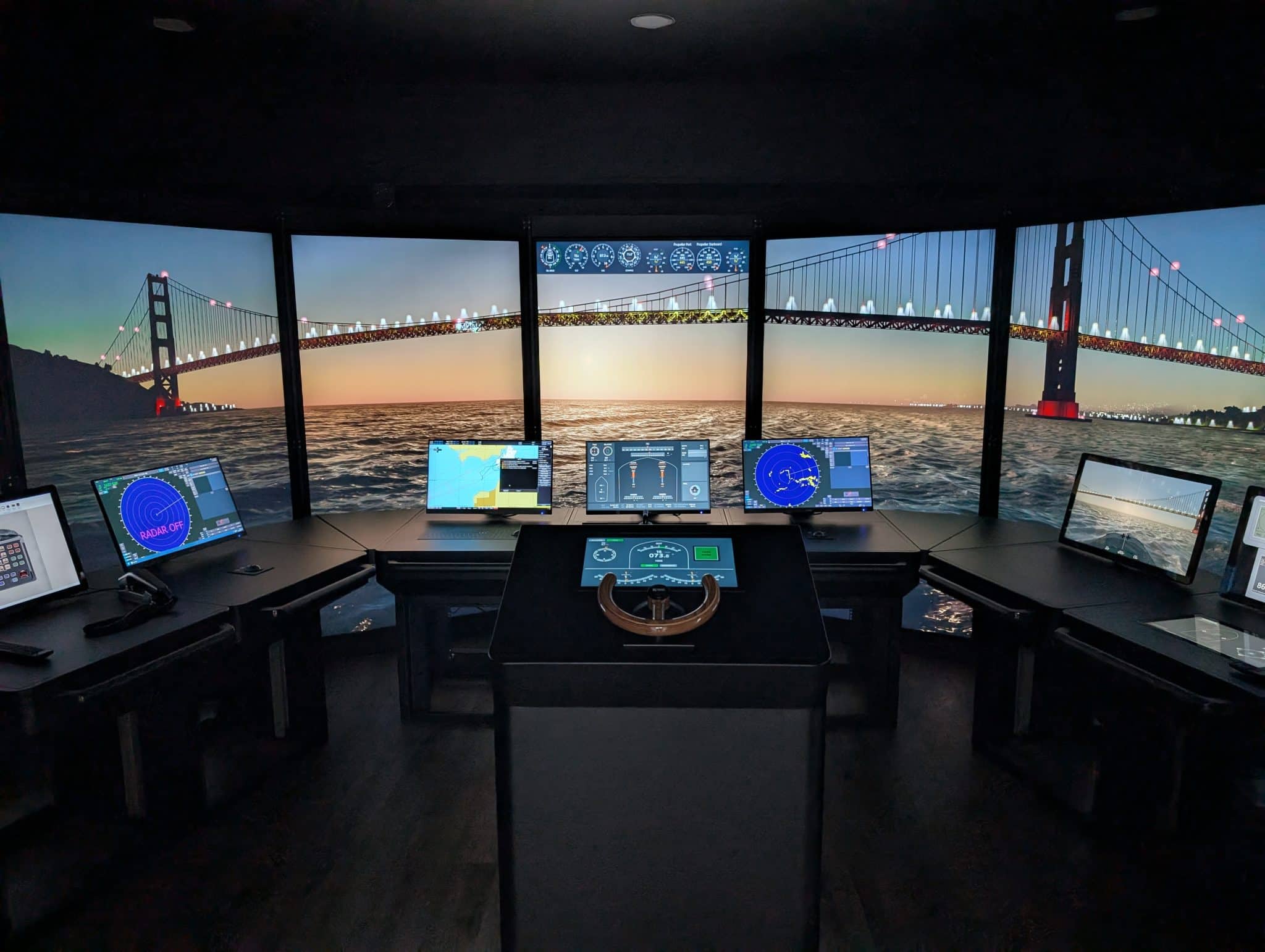
26/06/2025 – A bridge simulator is an advanced system combining hardware and software designed to replicate the operational environment of a ship’s bridge, including consoles, screens, navigational systems, and physical controls. These systems simulate vessel behavior, port environments, weather conditions, traffic patterns, and emergencies in real time, providing an immersive and realistic training environment for maritime professionals. In this blog, we delve into the core applications of bridge simulators in maritime training, highlight the benefits they offer for operational safety and bridge team performance, and showcase how the NAUTIS Simulator by VSTEP delivers a future-ready, standards-compliant solution for the evolving needs of the maritime industry.
Looking for the NAUTIS range rather than a definition? Our bridge simulator overview sets out the available configurations side by side.
What is a bridge simulator used for?
Bridge simulators serve a variety of purposes in the maritime sector. Here are the three most prominent applications:
- Training & assessment
Bridge simulators enable hands-on, practical training in a risk-free, controlled environment. Trainees develop essential skills in ship handling, execute complex maneuvers, and run through emergency drills. They’re also ideal for training in Bridge Resource Management (BRM), enhancing teamwork, communication, and situational awareness. Research shows simulator-based BRM training enhances communication, coordination, and reduces incidents during exercises.
- Competency evaluation
Simulators are widely used in performance assessments and certification. The STCW Code mandates simulator usage for competency tests, and research underscores the need for objective, scenario-based assessments that reflect real-world navigation and decision-making skills.
- Operational research & scenario testing
Beyond education, bridge simulators are used to simulate new maritime infrastructure. Ports, engineering firms, and government agencies rely on simulation to test harbor expansions, dredging effects, and vessel traffic scenarios. By modeling environmental conditions, tides, and vessel interactions, simulations help identify safety concerns and optimize design long before any physical construction takes place.
The benefits of bridge simulators in training
Bridge simulators deliver measurable value for both trainees and institutions. Here are some of the standout benefits:
- High-fidelity vessel & environmental modeling: Advanced hydrodynamic mathematical models replicate the movement of ships with remarkable accuracy. Combined with 3D visuals and authentic instrumentation, simulators like NAUTIS offer a learning environment that closely mirrors the complexities of real-life maritime navigation.
- Risk-free exposure to complex scenarios: Whether facing rough seas, heavy traffic, or engine failures, trainees can encounter high-stress situations in complete safety. This reduces the learning curve and builds decision-making confidence without the dangers of real-world exposure.
- Enhanced debriefing capabilities: Simulators include powerful tools for logging and reviewing sessions. Instructors can replay scenarios, analyze crew interactions, and assess decision-making. This feedback loop is essential for skill development and long-term learning.
- Improved knowledge retention: Research shows that interactive, scenario-based learning results in better retention of concepts and procedures compared to passive classroom instruction. Simulation accelerates the acquisition of critical ship-handling and emergency response skills.
- Consistent and accessible training availability: Unlike real vessels, simulators are always ready for training. They provide year-round access to repeatable, scalable training modules, ensuring continuity and flexibility for institutions and learners alike.
Introducing NAUTIS Simulator by VSTEP
Since 2008, NAUTIS Simulator has empowered maritime training institutions with highly scalable, immersive environments that reflect the complexity of modern maritime operations. Engineered for realism, NAUTIS combines high-fidelity 3D visuals, true-to-life vessel motion, and accurate hydrodynamic modeling to mirror real-world conditions with precision.
NAUTIS is built for flexibility. Whether you need a desktop solution or a full-mission bridge simulator, it adapts seamlessly to the infrastructure of your training facility. The simulator supports a wide array of operational scenarios, including navigation, tug operations, emergency response, inland waterways, naval exercises, and fishing operations. For officer and cadet training on professional instruments, see our ship bridge simulator.
Certified for quality, the NAUTIS Maritime Full Mission Bridge Simulator is approved in accordance with DNV-ST-0033 standards, while the NAUTIS Inland Simulator is the only maritime simulator in the market meeting CESNI requirements. It comes equipped with a comprehensive scenario library, intuitive instructor tools, performance analytics, and built-in debriefing capabilities.
Moreover, NAUTIS supports the development of IMO (International Maritime Organization) model courses, enabling realistic simulation training and assessment.
Elevate your maritime training with NAUTIS Simulator
Whether you’re training future officers, assessing professional competencies, or conducting operational research, the NAUTIS Simulator offers a flexible, high-fidelity solution that meets the highest industry standards. Backed by VSTEP’s two decades of experience in simulation, NAUTIS helps maritime institutions worldwide deliver effective, immersive, and compliant training.
Access advanced maritime simulation today with NAUTIS – the bridge to safer, smarter navigation.
Updated on 28-07-2026: added a summary table and frequently asked questions.
Bridge simulator classes at a glance
| Class | Training scope | Learn more |
|---|---|---|
| Full mission | Complete bridge team training, BRM/BTM and assessments | Full mission bridge simulator |
| Multi-task | Officer and cadet skill training on professional instruments | Ship bridge simulator |
| Limited task | Familiarisation, procedures and desktop training | Portable simulator |
Frequently asked questions
Which classes of bridge simulator exist?
Classification societies distinguish full mission simulators for complete bridge team training, multi-task simulators for officer and cadet skill training, and limited task systems for familiarisation and desktop exercises. The class determines the training scope, which is why academies usually combine classes rather than buying one of everything.
What equipment does a professional bridge simulator include?
A professional setup combines outside view displays, radar, conning and instrument panels, ECDIS and GMDSS stations, and an instructor station for scenario control and debriefing. Fidelity matters more than quantity: instruments must behave like their real counterparts for training to transfer to the actual bridge.
Does bridge simulator training count under STCW?
Simulator-based training and assessment are recognised within the STCW framework when the simulator is fit for purpose. DNV certification is the accepted way to demonstrate that suitability, and simulators built to those standards support courses from navigation and ship handling to GMDSS and bridge resource management.
How do training centres choose the right bridge simulator?
Start from the course portfolio. Certificate courses and team assessments call for a full mission setup, skill and instrument training runs well on multi-task configurations, and desktop stations extend capacity affordably. A structured demo with your own scenarios is the fastest way to test whether a platform fits your curriculum.
Take the next step
Compare configurations on our bridge simulation overview or book a demo to experience a NAUTIS bridge scenario yourself.


