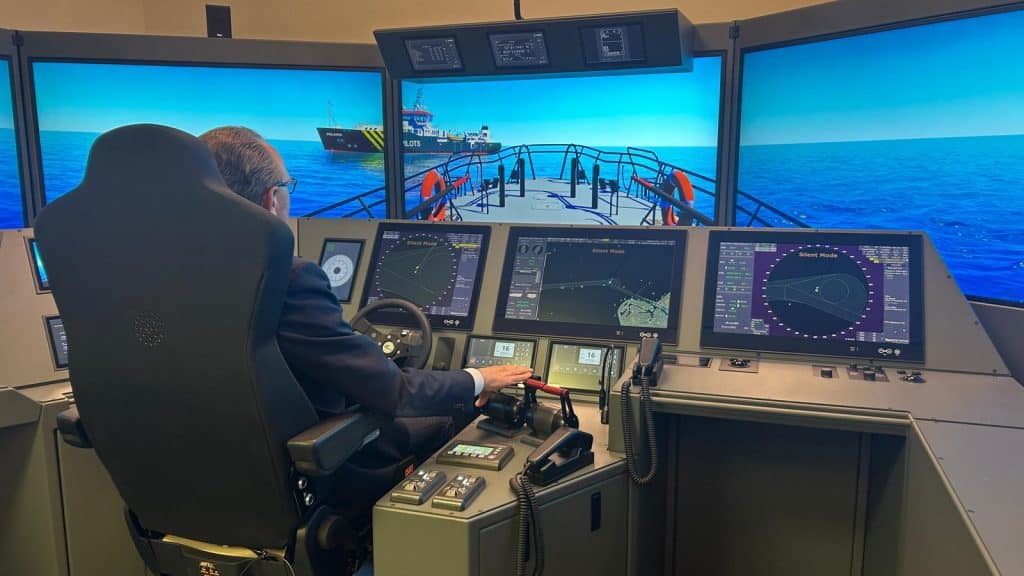
VSTEP has supported the Dutch Pilotage Service Organization with a custom NAUTIS simulator solution designed around its pilot transfer operations. By investing in a Full Mission Bridge configuration with vessel-specific controls, tailored interfaces, and long-term support, the learning environment works to help their crews prepare for safe pilot transfers in challenging conditions.
For the Dutch Pilotage Service Organization, pilot transfer readiness depends on crews who can act with confidence when weather, traffic, vessel motion, and time pressure converge. To support that need, the organization chose a NAUTIS simulator solution from VSTEP built around its pilot transfer operation. In March 2026, VSTEP completed the handover of a comprehensive simulator learning ecosystem of products and services designed to strengthen readiness across that operation.
The Dutch Pilotage Service Organization supports the safe and efficient handling of more than 90,000 pilotage-required seagoing ships each year, 24 hours a day and in all weather conditions. Within that chain, its seagoing transfer crews bring pilots to and from ships using fast launches, tenders, SWATHs, and helicopters. Tender captains work in a demanding part of that process, where vessel familiarity, precise control, and quick decision making in challenging situations support every safe transfer.
Configured around pilot transfer operations
The solution was configured around the Dutch Pilotage Service Organization’s operational needs for its tender boats. A custom NAUTIS Pilot Boat Simulator in a Full Mission Bridge configuration, together with NAUTIS Instructor Station, gives crews and instructors a training environment designed for pilot transfer operations. Customer-specific controls and interfaces include Sperry Marine system interfacing, Hamilton controls, panel development, and a custom pilot vessel set with two trim variations for the new M class. This mirrors the control layout, vessel responses, and working routines crews rely on during pilot transfers.
That configuration helps readiness grow faster because the training environment reflects the work itself. Instructors can create repeatable exercises, vary conditions, and review key decisions through structured debrief. This helps crews build familiarity, sharpen judgement, and respond more effectively in challenging conditions.
Vessel-specific context
The learning environment also includes the ‘Polaris’ vessel model as part of the wider solution. ‘Polaris’ serves as an offshore pilot vessel within the transfer operation, supporting the movement of pilots between ships, smaller craft, and shore. Including that vessel in the learning environment helps place pilot boat training in the broader operational context crews work within.
Continuity through the Subscription Value Plan
The five-year Subscription Value Plan is a defining part of the project because it extends the simulator’s usefulness over time. The Dutch Pilotage Service Organization gains continuity in NAUTIS software together with maintenance and support across the term, helping the learning environment remain available, current, and effective as operational needs evolve.
That continuity is reinforced by the services around the simulator. The agreed framework includes train the trainer delivery, maintenance and support services, direct support channels, and software upgrades. Together, these elements help the organization keep the learning environment aligned with instructor workflows and day-to-day readiness needs over time.
That practical focus comes through clearly in how the organization sees the value of the solution.
Stefan van der Stap of the Dutch Pilotage Service Organization said:
“VSTEP’s pilot boat simulator helps our crews build familiarity and make quicker decisions in challenging conditions. It also gives our instructors a consistent way to rehearse critical scenarios and review performance in support of safety across the pilot transfer operation.”
On behalf of VSTEP, Tije Vos, CCO, said:
“Our role is to enable the organization through a learning environment that truly fits the operation and keeps supporting crews and instructors over time. Through the NAUTIS ecosystem, we help translate operational reality into structured simulator learning that builds familiarity, strengthens consistency, and supports confident decision making in the conditions that define their work every day.”
This project shows how the NAUTIS ecosystem can support a highly specific maritime operation through one connected learning environment. For the Dutch Pilotage Service Organization, that means simulator capability designed around safety, familiarity, instructor control, and readiness in the demanding moments that define pilot transfer work every day.