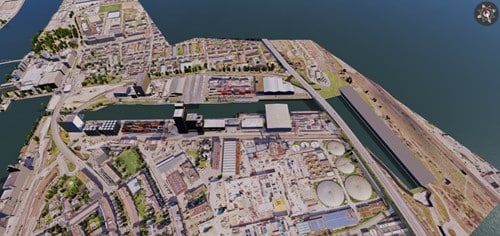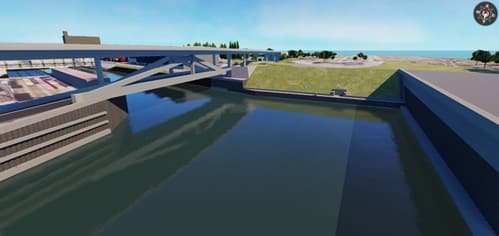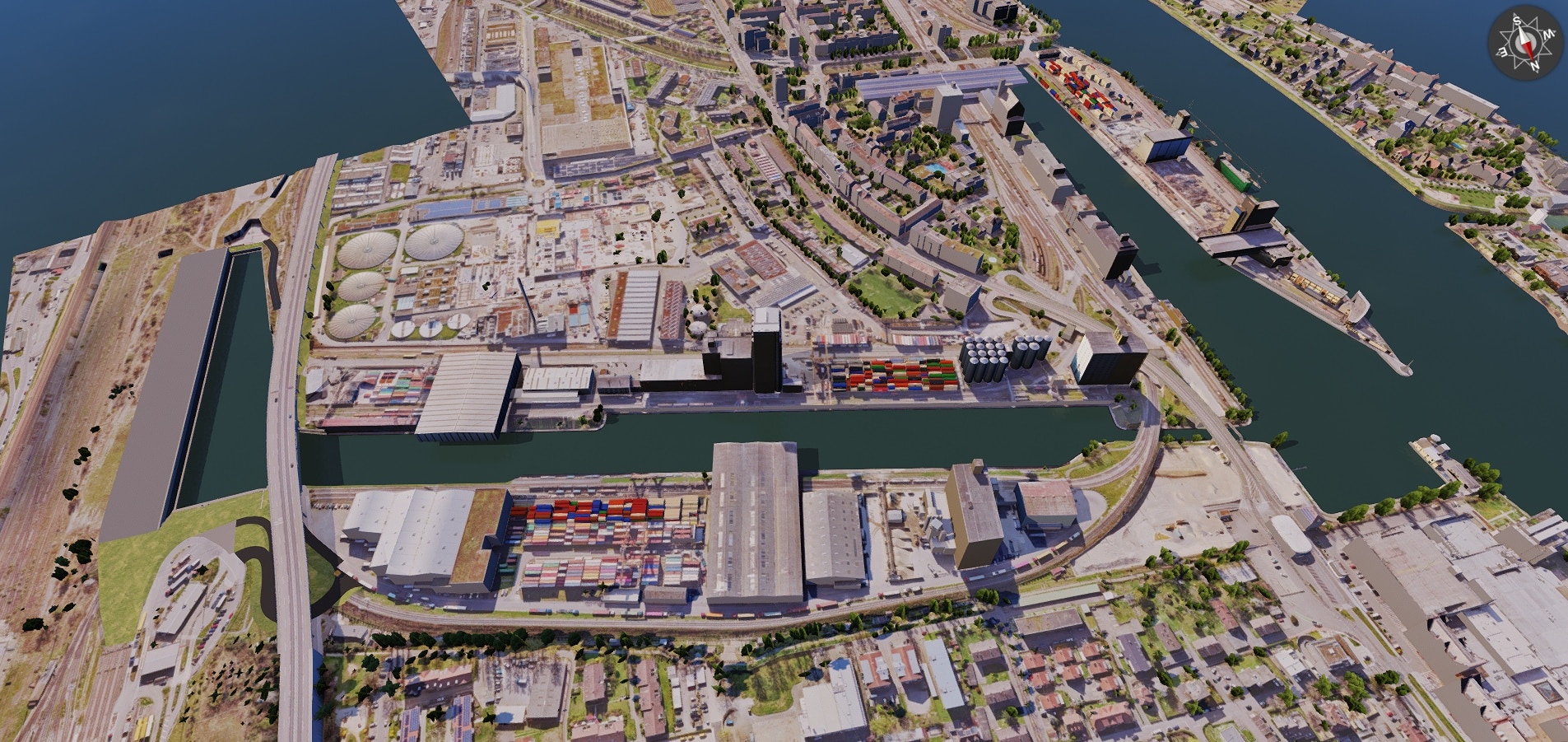
20/04/2026 – VSTEP has supported Port of Switzerland with a feasibility study for a proposed new harbour section in Basel, using the NAUTIS Simulator to validate safety margins and operational practicality before construction begins. By integrating the harbour concept into an existing detailed simulation environment for the Basel area, the study allowed pilots and operators to test different vessel types in realistic conditions, reducing uncertainty and giving stakeholders a stronger basis for design decisions.
When a new harbour concept is still on the drawing board, early decisions carry long term consequences. Manoeuvrability, safety margins, and operational practicality all need to be understood before construction begins, while there is still room to adapt the design without costly changes later.
That is why Port of Switzerland used VSTEP’s NAUTIS Simulator to support a feasibility study for a proposed new harbour section in Basel. By testing vessel movements in a realistic digital environment before committing to construction, the project team could reduce uncertainty, validate key assumptions, and build confidence in the concept at an early stage.
Early validation creates strategic value
This project is a strong example of the value of simulation before investment decisions are finalised. At that stage, stakeholders are not yet asking how to train people in a finished environment. They are asking whether the concept itself is workable, whether vessels can operate safely within it, and whether the design supports real traffic in practice.
The Port of Switzerland already knew NAUTIS from training related activities, which created a useful starting point. VSTEP had also previously developed a detailed simulation environment for the Basel area together with a fleet of vessel models. Because the digital waterway already reflected the local operating context, the proposed harbour design could be integrated directly into the simulator.
This meant that pilots and operators were not evaluating an abstract layout. They were testing a future concept inside a familiar and recognisable environment, using vessel behaviour that reflected real operations.
Testing the concept before construction
A new harbour basin is a major investment, and one of the central questions in the study was clear.
Can different vessel types enter safely and operate within the planned space under realistic conditions?
Using NAUTIS, operators tested approaches inside the proposed layout. Repeating the same exercise across multiple vessel types made it possible to compare outcomes, identify where margins were comfortable or tight, and understand which design factors had the greatest operational impact.
That is where simulation brought clear value. Drawings and calculations remain essential, but they do not let stakeholders experience a concept as vessel traffic. Simulation adds that practical layer. It turns a design into an operational test and gives decision makers a stronger basis for discussion before money is committed.
As Jan Riemek, Port of Switzerland, explained:
“For us, VSTEP’s simulator gave us a practical way to validate whether the harbour concept would work for real vessel traffic before construction. It allowed us to place different vessel types into the basin and better understand manoeuvrability and safety in a realistic setting.”
More than a training tool
This case also highlights a broader role for maritime simulation. It is widely recognised as a powerful learning tool, but it can also support early stage operational and infrastructure planning when a location and its context are represented with sufficient fidelity.
By recreating the operating environment and introducing different vessel types, VSTEP helped create an evidence based validation process at a point when design choices were still flexible. That is a strategic advantage. It allows stakeholders to test assumptions, refine concepts, and build confidence before construction begins.
As Luuk ten Bergen, Business Developer at VSTEP, noted:
“Most people associate maritime simulators with education and skill development. But the same environment can also be used to analyse operational questions. By recreating a location and introducing different vessel types, stakeholders can examine how a concept might perform and discuss potential adjustments before anything is built.”
Reducing risk and supporting better decisions
For Port of Switzerland, the feasibility study provided a practical way to evaluate navigational safety against a real proposal before investment. For the wider sector, it shows how simulation can support better infrastructure decisions by reducing uncertainty early and creating a shared understanding of what works, what needs refinement, and what can move forward with confidence.
It is also a clear example of how VSTEP can contribute earlier in a project lifecycle. Not only after an environment is built and ready for training, but at the stage where concepts are still being shaped and validated.
If you would like to learn more about using simulation to support feasibility studies, port design validation, or inland navigation planning, contact VSTEP.