

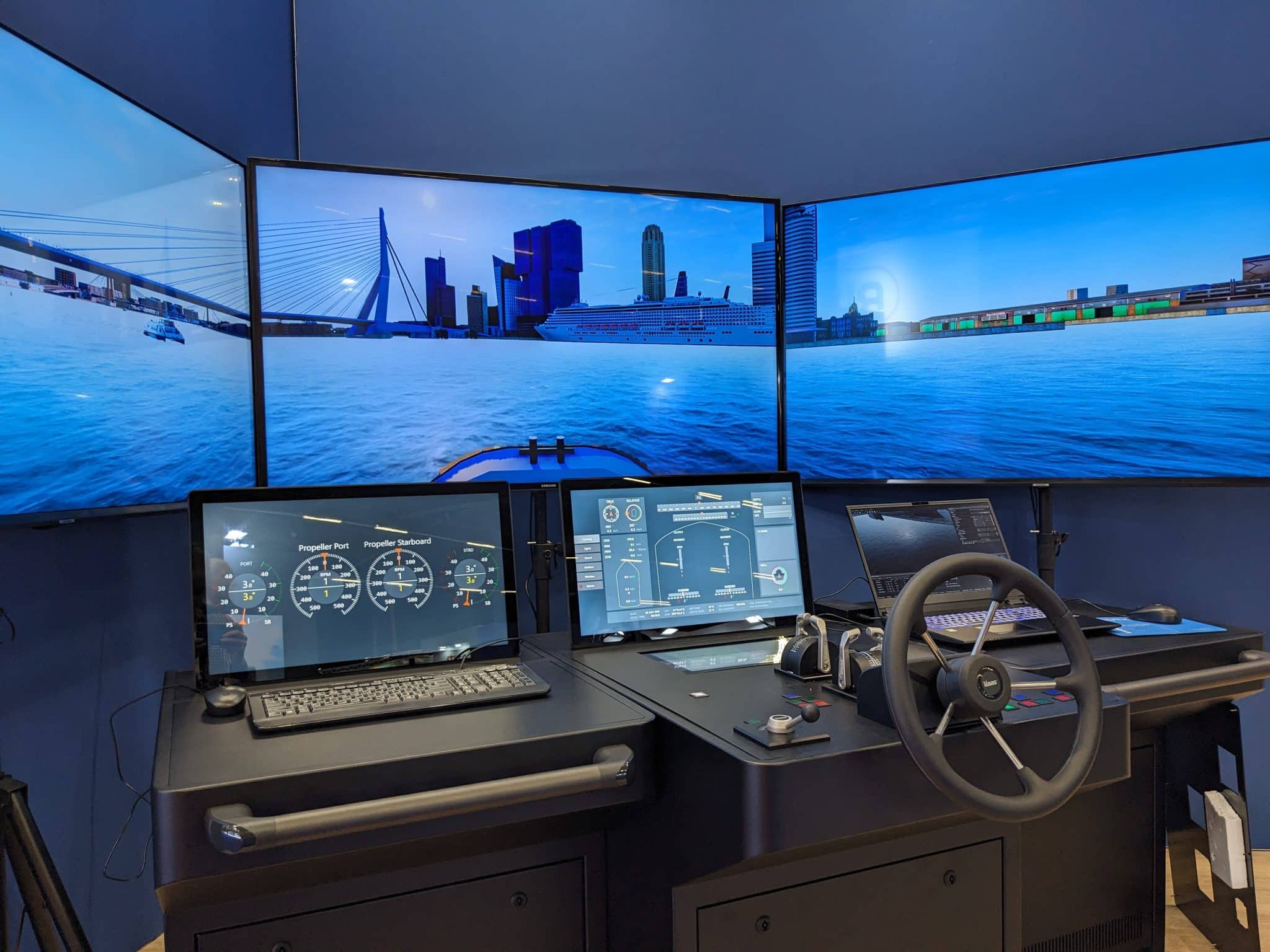
Maritime simulation training is changing the way shipping companies, academies, and maritime professionals prepare for complex challenges at sea. From engine failure to limited visibility, simulation offers a safe and structured setting to train real-world scenarios. This blog explores how maritime simulation contributes to safer manoeuvres and sharper decision-making in high-risk conditions.
Recent example: Strengthening readiness through simulation
High-risk manoeuvres that benefit from simulation
Some training scenarios are particularly well suited to a simulated environment:
- Emergency response: Handling engine loss, steering malfunctions, or blackout situations.
- Navigation in low visibility: Relying on radar and ECDIS to safely guide the vessel.
- Man-overboard response: Practising structured communication and quick decision-making.
- Shallow water navigation: Understanding hydrodynamic impact on vessel behaviour.
- Tug and towing operations: Coordinating vessel interactions in confined spaces.
These scenarios develop operational readiness and build confidence in a controlled, safe environment.
The role of the instructor
Simulation becomes truly effective when paired with expert instruction. Trainers use NAUTIS to build scenario-based exercises around real ports, vessel types and emergency cases. Training can be scaled in difficulty based on trainee experience. Debriefing tools and replay functions help identify what went well and what can be improved.
This structured approach supports long-term competence building and meets standards like the DNV. VSTEP offers the solution: DNV Certified Simulator for Maritime Training.
Bridging the gap between training and operations
Simulation complements onboard experience. It enables safe practice of rare, high-pressure situations that are difficult or dangerous to recreate in the real world. Trainees learn how to stay calm, prioritise actions, and coordinate as a team, all under realistic time pressure.
Organisations that embed simulation into core training programs often report measurable improvements in safety performance, communication, and decision-making, especially when combined with onboard practice, according to a recent study by Maritime Technology Review
Why NAUTIS is the best solution for your organisation
NAUTIS Simulators are designed to reflect the full complexity of modern maritime operations. They combine validated vessel hydrodynamics, flexible instructor tools, and high-fidelity visuals. Whether you’re training for deep-sea operations, inland navigation or emergency response.
At VSTEP, we’re proud to have earned certification and accreditation from:
Enabling learning by simulation
What we are proud of


NAUTIS Inland Simulator is the only maritime simulator on the market that fully meets the CESNI requirement.
LEARN MORE


Awarded Best Simulation & VR Solutions Innovators in the Netherlands and Most Advanced Maritime Simulation Platform: NAUTIS Simulator by CV-Magazine (2020)
LEARN MOREFrom maritime academies to public agencies, organisations worldwide trust NAUTIS to help crews develop and maintain essential skills.


