
A GMDSS simulator built into professional NAUTIS training
Distress and safety communication is one of the few skills a mariner may only ever use once, and it has to work first time. A GMDSS simulator lets crews rehearse the full Global Maritime Distress and Safety System in a safe, repeatable environment, so the right message goes out on the right equipment under real pressure. VSTEP builds GMDSS directly into the NAUTIS platform, alongside navigation, radar and ship handling, so communication training is part of a complete bridge exercise rather than a separate box-ticking module.
Every piece of GMDSS equipment, fully operational
The NAUTIS GMDSS communication tool recreates a complete, working radio station. Trainees carry out GMDSS procedures on simulated equipment that mirrors the layout and behaviour of the hardware on board:
- VHF with PTT handset and VHF (DSC)
- MF/HF with DSC
- NAVTEX receiver
- Inmarsat C, Fleet 77 and Inmarsat B
- EPIRB and SART
- Radar, GPS and RadioTelex
- Portable VHF and AirBand VHF
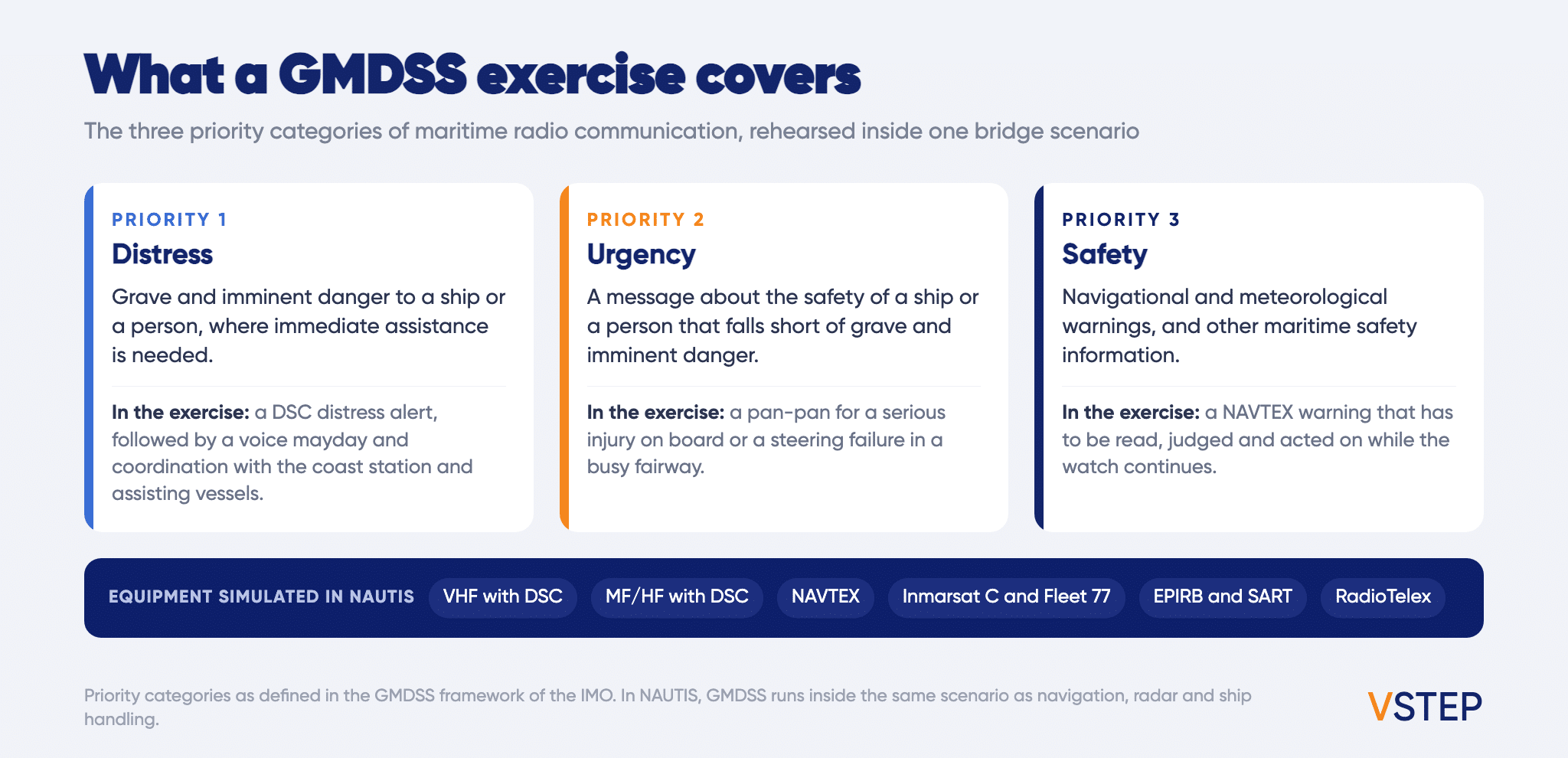
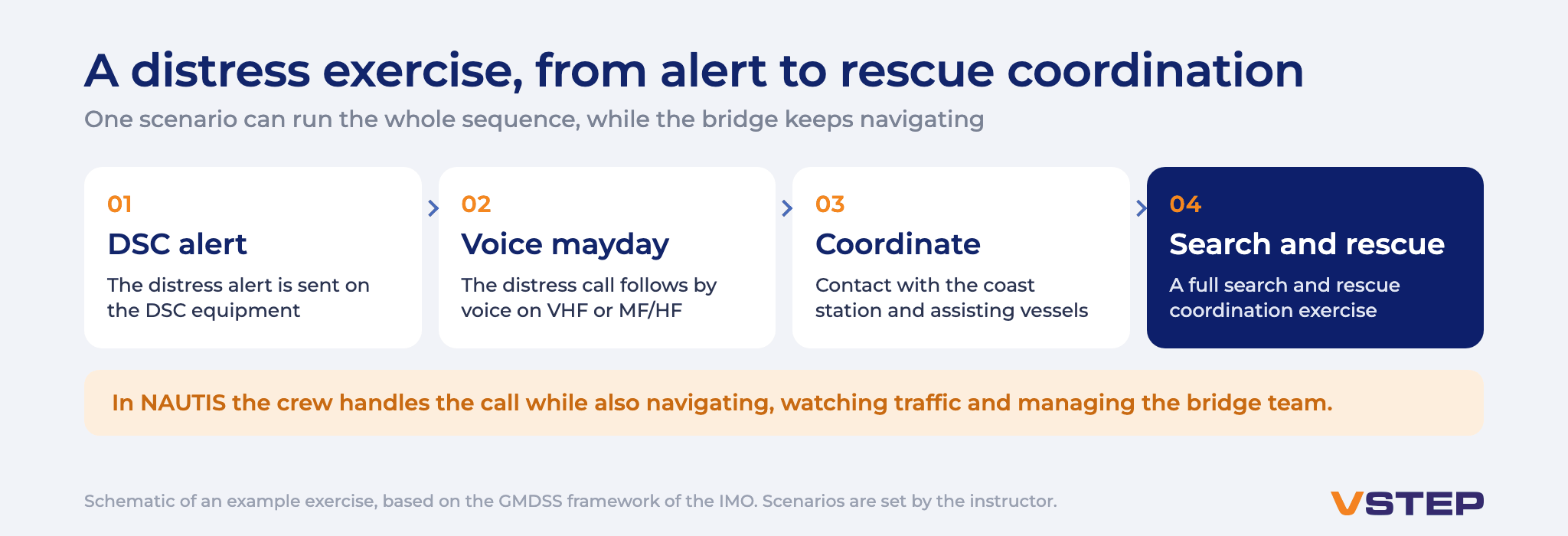
Because every function is live, instructors can run genuine distress, urgency and safety scenarios, from a DSC alert and voice mayday to a full search and rescue coordination exercise.
How GMDSS training in NAUTIS relates to STCW, IMO and DNV
GMDSS in NAUTIS is built around the equipment and procedures set out in the IMO GMDSS framework, and it runs on NAUTIS, a DNV certified simulator. Whether a specific GOC or ROC course meets STCW requirements is decided by the national administration that approves that course, so the simulator supports your programme rather than replacing that approval. You can read more about the framework itself in the IMO’s GMDSS overview and the STCW Convention.
Which NAUTIS configuration includes GMDSS?
- Standard Class A: includes Vox Maris GMDSS alongside navigation, ship handling and BRM/BTM, ideal for academies running STCW courses.
- Pro Class A: full GMDSS for high-stakes, advanced training at professional training centres.
- Premium Class A: full GMDSS for advanced STCW training and research applications.
Part of a complete bridge
A GMDSS simulator is most effective when communication training happens in context. In NAUTIS your crew handles a distress call while also navigating, watching traffic and managing the bridge team. Combine GMDSS with a bridge simulation setup, add ship handling exercises, or explore the full NAUTIS simulator platform to see how the elements fit together.
Frequently asked questions
Is the NAUTIS GMDSS simulator suitable for STCW courses?
It is used for GOC and ROC training and for refresher training, because it covers the equipment and procedures described in the IMO GMDSS framework. Approval of a specific STCW course stays with the national administration that certifies it.
Which GMDSS equipment is simulated?
NAUTIS simulates VHF with DSC, MF/HF with DSC, NAVTEX, Inmarsat C, Fleet 77, Inmarsat B, EPIRB, SART, Radar, GPS, RadioTelex, Portable VHF and AirBand VHF, all with fully operational GMDSS procedures.
Can GMDSS training be combined with navigation and radar exercises?
Yes. GMDSS is integrated into the NAUTIS Class A bridge, so communication, navigation, radar and ship handling can all run inside the same scenario.
Is the platform certified?
NAUTIS is a DNV certified simulator, assessed against DNV-ST-0033. That certification covers the simulator itself; the approval of a course delivered on it rests with the relevant administration or training organisation.
Want to see the GMDSS simulator in action? Book a demo and we will walk you through a live distress and safety scenario on NAUTIS.


