

The maritime skills gap is widening even as more people enter the profession, and that paradox is why maritime professional training now sits at the centre of the workforce debate. The 2026 Seafarer Workforce Report shows the officer shortage growing despite a larger and qualified talent pool. The question is no longer only how many people join shipping. It is how they become competent, certified, and retained.
This changes the task for academies, operators, and administrations. The maritime skills gap is often framed as a recruitment issue, but the challenge runs deeper. It sits within the full workforce pathway. Shipping needs people who can move from early interest into maritime education, from education into practical competence, and from competence into sustainable careers.
When that pathway works, the industry gains capable professionals. When it breaks down, potential is lost at multiple stages, before incoming talent can reach the bridge.
What the maritime skills gap means
Seafarers are expected to operate increasingly complex systems and work confidently with new digital tools. Future-ready competence now moves beyond technical skill to situational awareness, communication, sound judgement, and the ability to adapt.
The maritime skills gap is the difference between the skills the industry needs and the skills the available workforce can provide. It is not only measured by the number of unfilled jobs. It also includes the time and training needed for a cadet to become an independent, certified officer. In this sense, the skills gap is first a skills and competence issue, and then a recruitment issue.
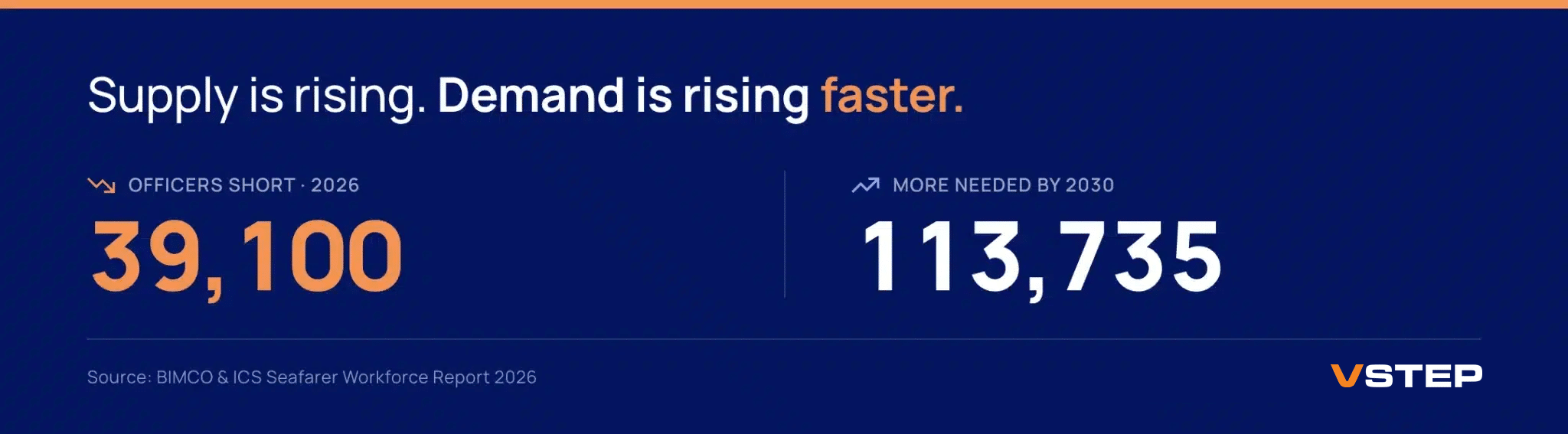
The figures support this. The 2026 report estimates that 2.57 million seafarers operate 85,148 merchant ships, yet 2026 still shows a shortage of 39,100 certified officers, with demand for an additional 113,735 officers by 2030 (BIMCO and ICS). Supply is rising but demand is rising faster.
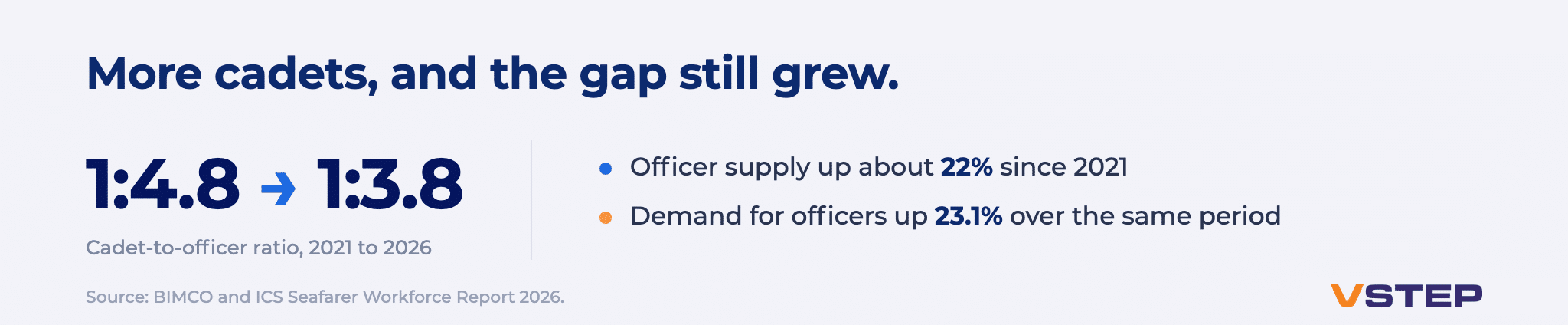
Between 2021 and 2026 the supply of certified officers grew by about 22 percent and the cadet to officer ratio improved from 1:4.8 to 1:3.8 (BIMCO and ICS, Seafarer Workforce Report 2026), yet the officer shortage still widened. Adding cadets to the pipeline did not close the gap, because competence and demand both moved faster than headcount.
Why recruitment alone will not close it
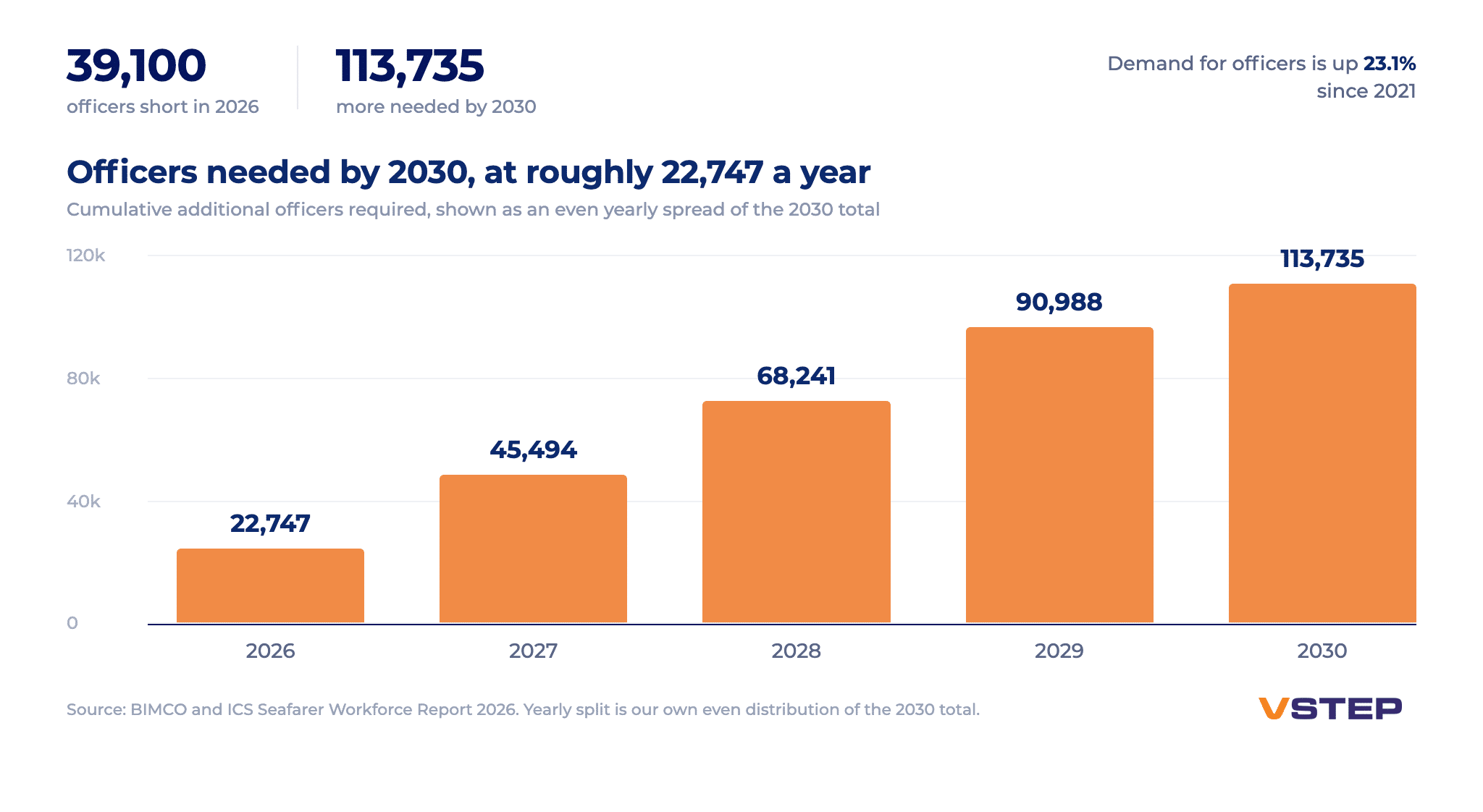
The 2026 data describes a workforce moving in two directions at once. The maritime industry is facing a shortage of qualified officers, even though there are more crew members available for other onboard roles than currently needed. Demand for officers has gone up by 23.1 percent since 2021 (BIMCO and ICS). Meeting the projected need of 113,735 additional officers by 2030 will require around 22,700 maritime officers to join the workforce each year. Those officers cannot be recruited into existence overnight, because each one represents years of training, sea time, and assessment.
That is why the maritime skills gap behaves like a training capacity problem. The constraint is the rate at which the pathway converts interested entrants into competent, certified officers, and then keeps them. Demand is also changing shape. Shipping carries more than 80 percent of world trade by volume (UNCTAD), and crews now operate more complex systems and prepare for alternative fuels, an area where the IMO is developing training and safety guidance (IMO). The workforce does not only need to be larger. It needs to be more capable.
Untapped talent is part of the answer, but the pathway stays uneven
Recruitment alone will not close the gap, but the industry is also not using all the talent it already has. The IMO-WISTA Women in Maritime Survey found that women make up a small share of seafarers, even though participation across the wider maritime workforce is higher, pointing to barriers in access and progression rather than a lack of interest (IMO-WISTA).
Research from World Maritime University and the Lloyd’s Register Foundation shows a similar pattern in other regions: enrolment in maritime education is growing, but graduation and progression into employment do not always keep pace, held back by limited sea-time berths, training costs, and infrastructure constraints (WMU, Lloyd’s Register Foundation). The pattern holds across sources: interest and capability exist, but the route from education to employment is not always reliable.
Where maritime professional training changes the maths
Maritime professional training is the force that turns intake into capability. Structured training programmes shorten and standardise the route to competence, and make progress measurable. This is where the pathway either scales or stalls. When training capacity is limited, qualified entrants stay stuck below the level the fleet needs, and the gap holds even as enrolment grows.
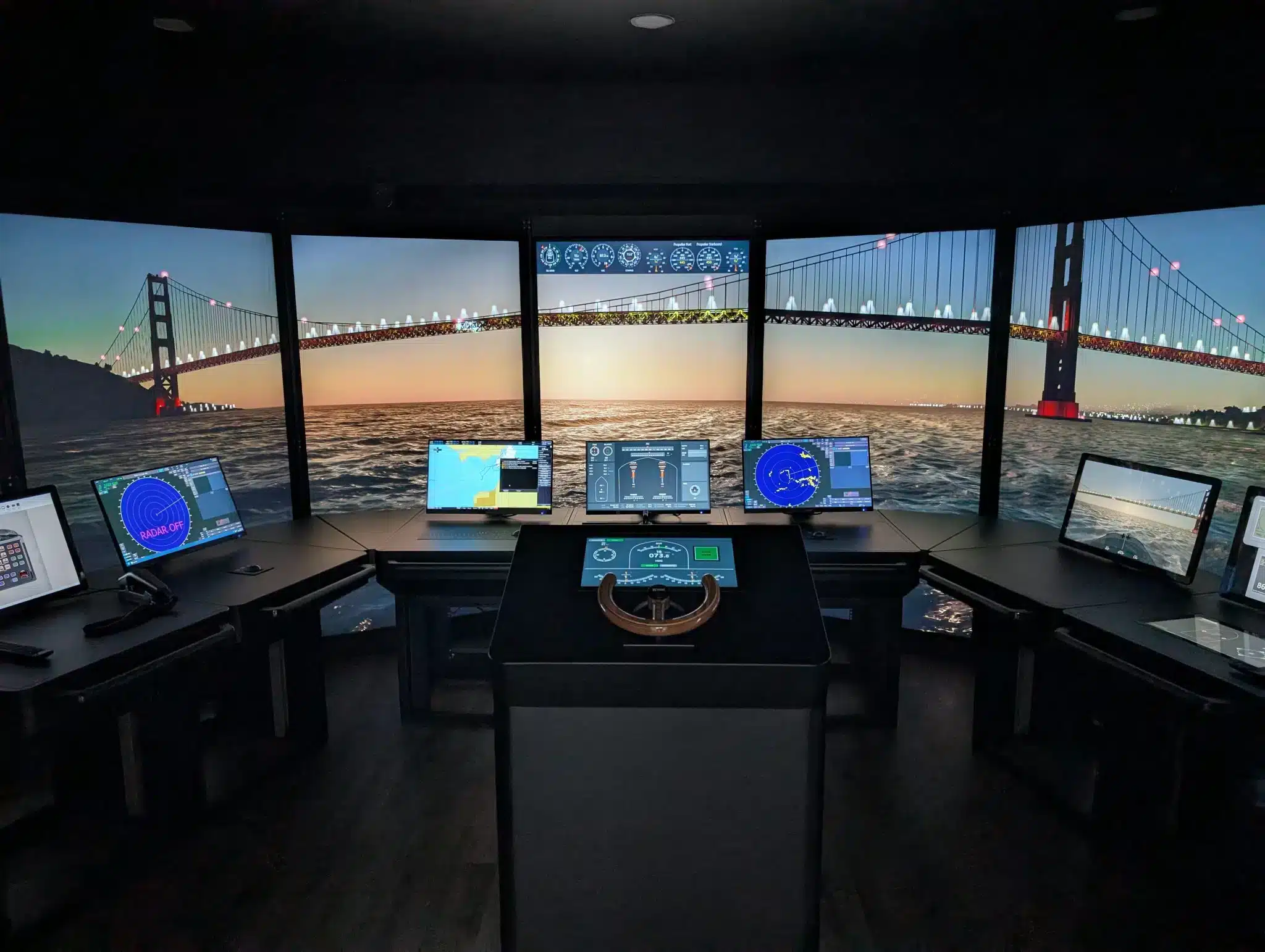
Simulation raises that capacity. Maritime simulation training lets trainees apply knowledge, make decisions, and see the consequences in a controlled setting, then repeat the exercise until performance is consistent. Simulation is a recognised part of maritime training, with the STCW Convention setting performance standards for simulators used in training and competence assessment (IMO).
Using ship handling simulation to increase training capacity
A ship handling simulator reproduces vessel hydrodynamics and lets trainees rehearse berthing, dense-traffic transits, and emergencies that are rare or unsafe to practise at sea. Because these scenarios can be repeated and assessed, competence is built faster and proven more reliably, which is one reason a bridge simulator helps prepare crews for the unexpected. The same logic applies to focused navigation training, where repeated practice turns procedure into judgement.
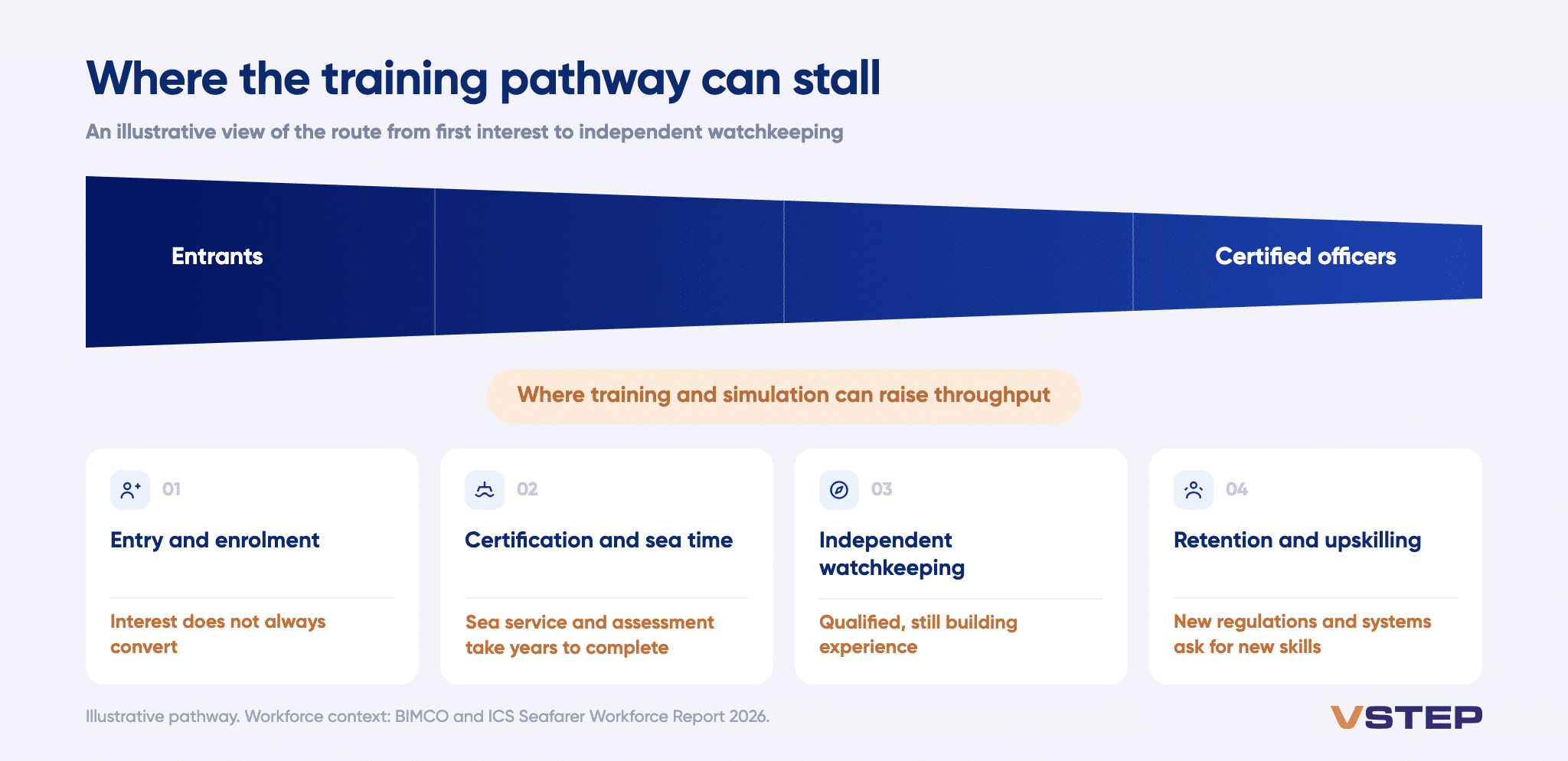
The table below maps where the pathway leaks and how training and simulation close each gap.
| Stage in the pathway | Where the gap opens | How professional training closes it |
|---|---|---|
| Entry and enrolment | Interest does not always translate into enrolment | Realistic early exposure through maritime simulation |
| Certification and sea time | Limited sea-time berth availability can slow qualification | Ship handling simulation makes critical practice repeatable |
| Independent watchkeeping | Cadets qualify but lack confident, tested competence | Scenario-based assessment builds and proves readiness |
| Retention and upskilling | New fuels and digital systems outpace current skills | Recurrent maritime professional training keeps crews current |
Source: analysis based on BIMCO and ICS (2026) and UNCTAD data.
Retention is more than a training question
The retention row above focuses on keeping pace with new fuels and digital systems, but upskilling is only one part of what keeps qualified officers in the industry. Working conditions, career progression, and wellbeing all influence whether experienced professionals stay. When people see a credible route to advancement and know their training keeps them current, they are more likely to remain rather than move to shore-based or unrelated work.
Losing an experienced officer early costs more than an open vacancy: it also removes someone who could otherwise help train the next cadet through the pathway described above, which is why retention sits alongside training capacity rather than behind it.
The instructor remains central to training capacity
Simulation raises training capacity, but it does not run itself. Instructors design scenarios, guide exercises, and lead the debriefs that turn a session into learning, connecting what a trainee experienced with what they still need to work on.
Clear workflows and a consistent training environment let instructors spend that time on teaching rather than on managing systems.
How VSTEP supports maritime professional training
VSTEP develops maritime simulation software used by training centres, academies, and operators worldwide. Our NAUTIS simulators provide full-mission bridge simulation and ship handling simulation, with tools for scenario design and structured debriefing that help turn practice into skill. For individual learners and aspiring professionals, NAUTIS Home extends realistic practice to a laptop setup, so learning can continue between formal sessions and before sea time.
The aim is to train more people effectively without lowering the quality of learning. Reliable tools and repeatable practice help instructors use their time well and help more trainees progress their maritime career. You can explore the full-mission platform on the NAUTIS Simulator page.
Frequently asked questions
What is the maritime skills gap?
The maritime skills gap is the growing distance between the competence the world fleet needs and the competence the available workforce can supply. It reflects both a shortage of certified officers and the time and training needed to bring entrants to independent, certified competence, so it is a capability challenge as much as a recruitment one.
Is the maritime skills gap a recruitment problem or a training problem?
It is both, and the training side is increasingly the binding constraint. The 2026 workforce data shows officer supply rising while the shortage still widens, because demand and required competence grow faster than headcount. Recruitment brings entrants in, but maritime professional training determines how quickly they become capable, certified officers who stay in the profession.
How does ship handling simulation help close the gap?
Ship handling simulation expands practical training capacity. A ship handling simulator lets trainees rehearse berthing, dense-traffic transits, and emergencies safely and repeatedly, building and proving competence that is hard to guarantee at sea. This raises throughput for academies and operators and shortens the route from entry to independent watchkeeping.
Can simulation replace sea time?
No. Sea time remains essential for real seafaring competence. Maritime simulation complements it by preparing trainees for situations that are difficult to arrange onboard and by making critical scenarios repeatable and assessable. Used together, simulation and sea time create a faster, more reliable pathway from education to professional competence.
Building the workforce shipping needs
The maritime skills gap will not close through recruitment alone. It closes when maritime professional training turns incoming talent into competent, certified officers at the rate the fleet requires. If your academy, training centre, or fleet wants to raise training throughput and strengthen readiness, explore how NAUTIS Simulator supports ship handling simulation and scenario-based training, or reach out through the contact page to discuss your goals.


