

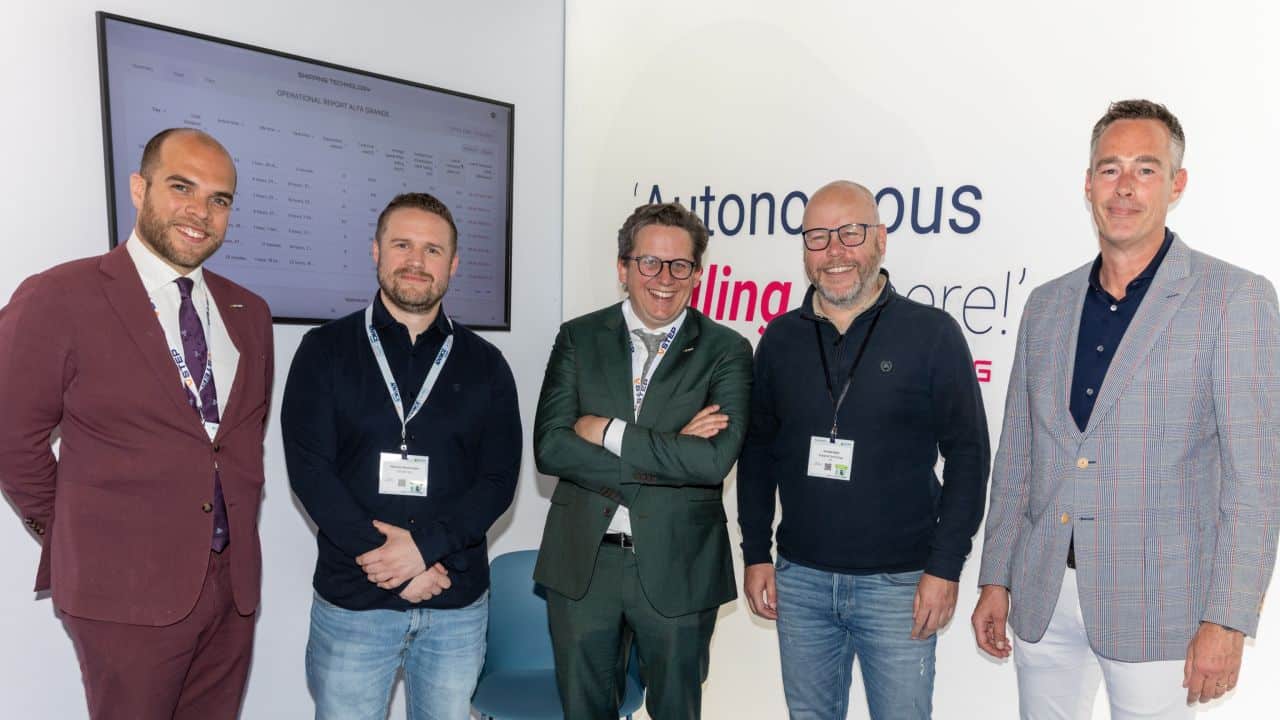
27-5-2025 (updated on: 19-05-2026) – VSTEP and Shipping Technology have announced a new partnership that connects real operational vessel data with the NAUTIS maritime simulator. Announced during Maritime Industry 2025 in Gorinchem, this collaboration marks a significant step forward in maritime simulation training for inland shipping crews, bringing the virtual training environment closer to the actual conditions crews face on European waterways every day.
From Operational Data to Training Scenarios
Inland shipping crews operate in increasingly complex environments. Evolving regulations, high-traffic waterways, changing water levels and new onboard technologies all create challenges that traditional training methods struggle to address with sufficient specificity. Generic simulator scenarios can prepare crews for broad situations, but they cannot replicate the precise conditions of a specific route, vessel or operational moment.
This is the gap that the VSTEP and Shipping Technology partnership addresses directly.
Shipping Technology’s ST BRAIN system captures detailed voyage data from real inland vessels, including propulsion settings, heading, traffic interactions and timestamps. Previously used for fleet analytics and monitoring, this data will now be used to construct realistic ship handling training scenarios within VSTEP’s NAUTIS simulator. Crews can revisit and practise high-impact operational moments such as near misses, bottleneck navigation and route-specific risk points.
“With this step, we’re bringing the virtual and real world of inland shipping closer together. It marks an important milestone in our mission to use technology as a support tool for crew members.”
— Donald Baan, COO of Shipping Technology
What Data-Driven Simulation Training Makes Possible
The integration of real voyage data into simulator training changes the relationship between operational experience and structured learning. Rather than training on estimated or generic conditions, operators can now work through scenarios built directly from their own fleet’s operational history.
This has concrete implications for maritime simulation training quality and outcomes:
- Near miss review: Incidents or close calls that occurred during real operations can be reconstructed in the simulator, allowing crews to analyse what happened and practise alternative responses in a safe environment
- Route-specific preparation: Crews preparing for a new route or waterway can train on scenarios built from data collected on that specific route, including traffic patterns, bottlenecks and environmental conditions
- Procedural refinement: Operational moments where procedures were unclear or suboptimal can be isolated and used as the basis for targeted ship handling training sessions
- Emergency preparedness: Reconstructed scenarios provide a structured basis for emergency drills that reflect actual rather than hypothetical operational conditions
“At VSTEP, we strive to make simulation more relevant and connected to real-world maritime challenges. This collaboration allows the integration of actual operational data, making learning more practical, focused, and reflective of everyday conditions.” — Tije Vos, CCO at VSTEP
Why This Matters for Inland Shipping
Bridge simulators have long played an important role in maritime training. However, many training sessions are based on generic or estimated conditions that may not reflect the specific waterways, vessel types and traffic dynamics a crew regularly encounters. The result is a gap between what is practised in the simulator and what is experienced in real operations.
By anchoring maritime simulation training in actual voyage data, this partnership closes that gap. Training becomes more relevant, more specific and more directly transferable to the operational environment. Retention improves because the scenarios are recognisable. Confidence builds because the training reflects the real conditions crews face.
This is also the first collaboration between the two Rotterdam-based companies, and it reflects a broader trend in the maritime industry toward data-informed training and continuous competence development.
How operational data becomes a training scenario: the process
Based on the capabilities of ST BRAIN and NAUTIS, the following process illustrates how operational data can be applied in a training context
| Step | What happens | Result |
|---|---|---|
| Data collection | ST BRAIN captures voyage data including propulsion, heading, traffic and timestamps | Detailed record of real operational conditions |
| Data analysis | Operational moments of interest are identified: near misses, bottlenecks, risk points | Training-relevant events extracted from fleet data |
| Scenario construction | Selected data is used to build NAUTIS simulator scenarios replicating the operational moment | Realistic, route-specific training environment |
| Training delivery | Crews practise ship handling, decision-making and emergency procedures in the reconstructed scenario | Hands-on practice in conditions that mirror real operations |
| Debrief and review | Instructors use simulator replay tools to review crew performance against the original operational data | Structured feedback directly linked to real-world performance |
| Continuous improvement | Insights from training feed back into operational procedures and future scenario development | Ongoing cycle of learning and procedural refinement |
Interested in data-driven simulation training for your inland fleet? Explore the NAUTIS Inland Simulator or contact the VSTEP team to discuss your training objectives.
About VSTEP
VSTEP creates innovative simulation software for professional organizations worldwide. We are a team of 60 explorers who are always up for challenges. We are not constrained by standards and are flexible in our approach to fulfilling the mission: enable learning by simulation.
We are all dedicated to the same vision: ensure that at least one-third of the maritime industry has obtained their skills through our simulation technology. Hence, we strive to make a great contribution to creating a more sustainable world. We invest in continuous R&D of our software and work passionately as a team to get there.
A Strategic First
This marks the first collaboration between the two Rotterdam-based innovators. It also reflects VSTEP’s ongoing mission to provide added value through smart simulation technologies. The integration of these systems is a clear example of how simulator training and data insights can be combined to improve operational safety, reduce error, and enhance maritime education.
Together, VSTEP and Shipping Technology are enabling better decisions, sharper skills, and safer inland waterways.
Learn more about Shipping Technology
What is data-driven maritime simulation training?
Data-driven maritime simulation training uses real operational vessel data to construct training scenarios in a simulator. Rather than practising on generic or estimated conditions, crews train on scenarios built from their own fleet’s voyage history, including actual route conditions, traffic patterns and operational incidents. This makes training more specific, more relevant and more directly transferable to real operations.
How does Shipping Technology's ST BRAIN system work with NAUTIS?
ST BRAIN captures detailed voyage data from inland vessels during real operations, including propulsion settings, heading, traffic interactions and timestamps. This data is used to construct scenarios within the NAUTIS simulator that accurately replicate the conditions recorded during real voyages. Crews can then practise ship handling and decision-making in a virtual environment built from their actual operational experience.
What types of scenarios can be built from real voyage data?
Operational data can be used to reconstruct a wide range of training scenarios including near miss situations, bottleneck navigation, route-specific risk points, adverse weather encounters and emergency procedures. Any operational moment captured by ST BRAIN can in principle be reconstructed in NAUTIS, giving training organisations a continuously growing library of relevant, real-world scenarios.
Why is data-driven training more effective than generic simulation training?
Generic simulator scenarios prepare crews for broad operational situations but cannot replicate the specific conditions of a particular route, vessel or operational context. Data-driven training addresses this by anchoring scenarios in real experience that crews recognise. This improves relevance, supports better knowledge retention and builds confidence in a more targeted way, because the training directly reflects the conditions crews encounter in their actual working environment.


